



Catégories
- De nouvelles Haomei (354)
HVAC aluminum fin stock is a critical material for heat exchangers in air conditioners, pompes à chaleur, fresh air handling units, fan coil units, refroidisseurs, et équipements de réfrigération commerciale. Typically supplied as thin-gauge aluminum foil, the material is stamped by high-speed presses into fins featuring louvers, collared holes, and corrugated structures. These fins are then assembled with copper or aluminum tubes to form evaporators, condensateurs, and other air-side heat exchange components.
The role of fins in a heat exchanger is direct: they increase the air-side heat transfer area, guide airflow, enhance turbulence, and facilitate condensate drainage. Factors such as fin stock thickness, force, état de surface, coating adhesion, and stamping performance directly impact heat transfer efficiency, résistance à la corrosion, production cycle times, and the appearance of the finished product.
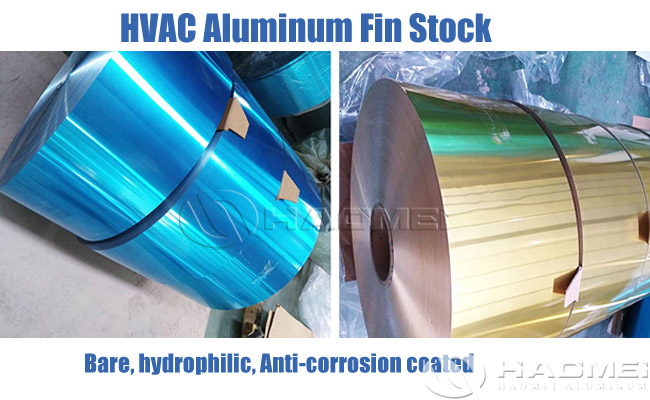
HVAC fin stock primarily utilizes 1000-series and 3000-series aluminum alloys; common grades include 1100, 3003, 3102, et 8011. Different grades are suited to specific equipment designs, stamping processes, and operating environments.
1100 aluminum fin stock features high purity, excellente conductivité thermique, and good formability, making it suitable for standard air conditioner heat exchangers and products requiring deep drawing or collar forming. The strength of 1100 alloy is relatively limited; when using thinner gauges, evaluation must consider factors such as fin pitch and die design.
3003 et 3102 aluminum fin stocks belong to the Al-Mn alloy series. Manganese enhances material strength and corrosion resistance, making these alloys ideal for commercial air conditioners, pompes à chaleur, condensing units, and applications requiring high fin rigidity. 3102 aluminum is widely used in heat exchanger applications and is suitable for high-speed stamping and complex fin geometries.
8011 aluminum fin stock offers good strength and processing stability, making it suitable for certain air conditioner fins and industrial heat dissipation applications. When selecting this material, it is crucial to verify the temper and forming requirements; excessive hardness can increase the risk of cracking during collar formation or defects during louver punching.
Common tempers for HVAC aluminum fin stock include O, H14, H22, H24, et H26. The O temper is soft with high elongation, making it suitable for processes requiring complex forming. H14 and H24 are semi-hard tempers that offer a good balance between strength and stamping performance. The H26 temper is harder and suitable for products requiring high fin stiffness, though die clearance and lubrication conditions must be optimized accordingly.
The typical thickness range for air conditioner aluminum fin stock is 0.08 mm à 0.20 mm, avec 0.09 mm, 0.095 mm, 0.10 mm, 0.11 mm, 0.12 mm, 0.13 mm, et 0.15 mm being the most common specifications. Fins for residential air conditioners typically range from 0.09 à 0.12 mm in thickness, while commercial air conditioners, pompes à chaleur, and large-scale refrigeration equipment may utilize materials between 0.12 et 0.20 mm, depending on structural requirements.
Standard widths generally fall within the 200 mm à 1,300 mm range, determined by factors such as the punch press feed width, die layout, and heat exchanger dimensions. Supply specifications must also define the coil inner diameter, weight per coil, maximum outer diameter, winding direction, edge burr requirements, and the permissible number of joints.
Based on surface treatment, HVAC fin stock is categorized into bare aluminum foil, feuille d'aluminium hydrophile, and anti-corrosion coated aluminum foil.
Bare aluminum foil retains the metal surface finish from the rolling process; it offers a short heat conduction path and relatively controllable costs, making it suitable for standard heat exchangers operating in stable indoor environments with low corrosion risk. toutefois, water droplets tend to form on its surface under humid conditions, and condensate drainage efficiency is significantly influenced by fin geometry and installation angle.
Hydrophilic aluminum foil features a hydrophilic coating applied to the aluminum substrate. This coating facilitates the spreading of condensate into a water film that flows down the fins, thereby reducing airflow resistance caused by water bridging and helping to mitigate risks associated with water accumulation, dripping, et les odeurs. Hydrophilic fins are commonly used in indoor units for residential air conditioners, déshumidificateurs, fresh air systems, and heat pump evaporators.
Anti-corrosion coated aluminum foil is primarily used in environments characterized by coastal locations, humidité élevée, brouillard salin intense, pollution industrielle, or exposure to acidic/alkaline gases. Common coating systems include epoxy, polyester, and composite functional coatings. Coating performance is evaluated based on a combination of factors: salt spray resistance, adhesion, resistance to heat and humidity, stamping durability, and long-term heat exchange efficiency. Excessive coating thickness can increase thermal resistance, while insufficient thickness fails to provide reliable protection; donc, the coating must be matched to the equipment’s operating environment.
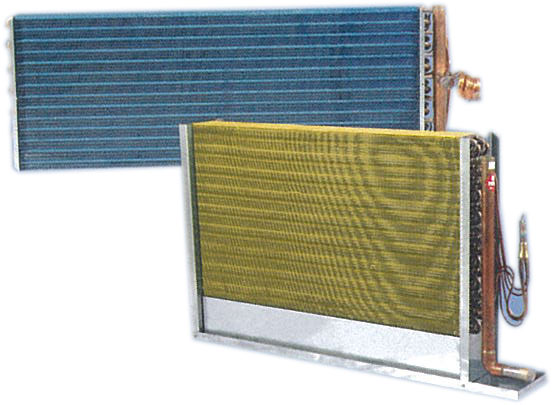
HVAC fin stock typically undergoes processes such as uncoiling, nivellement, alimentation, high-speed punching, louver forming, Flanger, and collection. The material must possess consistent thickness, platitude, and coil shape; edges must be free from cracks, burrs, bords ondulés, or significant camber that could disrupt continuous feeding.
The flanging hole area is particularly prone to issues during stamping. Insufficient material elongation, excessive hardness, or improper die radii can lead to cracks at the hole edges, incomplete flanging, or louver deformation. For coated fin stock, coating adhesion after stamping is also critical; issues such as large-scale paint loss, fissuration, or localized delamination must be avoided.
Practical production experience shows that the stability of HVAC fin stock cannot be judged by a single mechanical property alone. Factors such as thickness tolerance, coil tension, surface lubrication, coating uniformity, and batch-to-batch consistency all impact the continuous operation of high-speed stamping presses.
For standard residential air conditioners, suitable semi-hard base materials—1100 alloys—can be selected based on cost, heat exchange design, and stamping complexity. Alloys 3003 ou 3102 are well-suited for commercial air conditioners, pompes à chaleur, and heat exchangers requiring higher fin rigidity. Hydrophilic coated aluminum foil is recommended for equipment operating in humid environments or requiring specific condensate management, while anti-corrosion coating solutions—selected based on salt spray resistance ratings—are appropriate for coastal or corrosive environments.
Haomei Aluminum offers bare aluminum fin stock, stock d'ailerons en aluminium hydrophile, and coated aluminum fin stock for HVAC applications, covering common alloys such as 1100, 1200, 3003, 3102, et 8011. Before actual procurement, it is recommended to verify specifications—such as alloy, tempérer, épaisseur, largeur, coating color, poids de la bobine, and stamping performance requirements—against the heat exchanger drawings, and to validate the compatibility between the material and the die process through trial stamping.
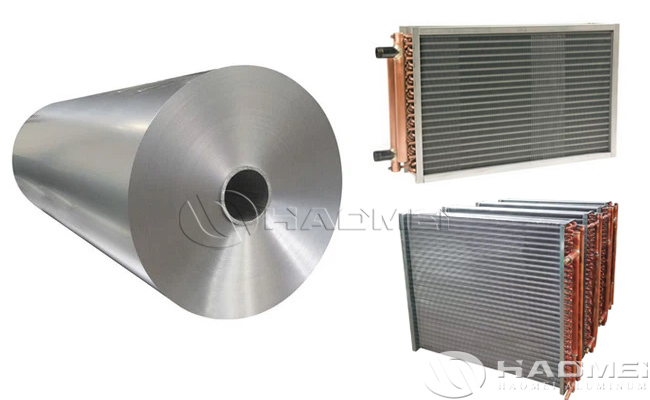 Feuille d'aluminium nue pour climatiseurs
 Stock d'ailerons en aluminium hydrophile doré
 Rouleau géant de papier d'aluminium industriel
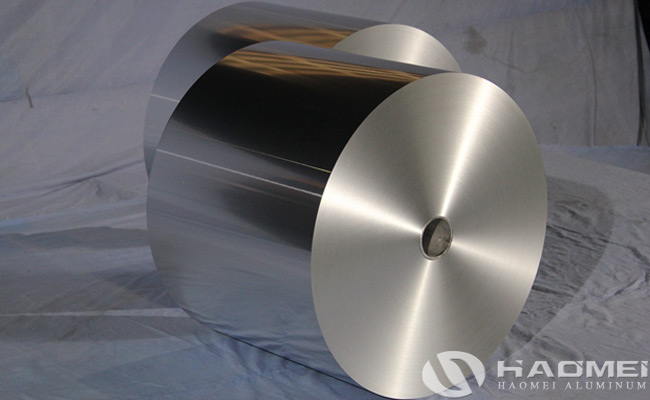 Rouleaux de papier d'aluminium industriels en Chine